My dear readers, I have been terribly remiss. I know I promised you all a final blog post, and it has been nearly a month since I made that promise. The delay is mostly due to finishing up my final paper and a fantastic three week vacation through Kenya, Tanzania, and Turkey with my family. The delay is also due to the fact that I wasn't really planning on getting around to this post; I figured no one was checking up on the ol blog anymore, and since this post is going to be a lot of me talking about my "feelings" and whatnot (spoiler alert!), and is largely self serving, I didn't feel too bad about neglecting Uganduh.
However, the wonderful Alex Rosenberg chastised my blog-break the other day, so I knew that at least one person would read my last post, so I decided to go ahead and write it.
It is hard to know where to start. As I have been catching up with friends at home, everyone always starts out with "Tell me about Uganda?!" This question always makes me laugh because it is just impossible to condense the depth and breath of four months in Uganda into a few sentence answer. My typical answer is to say it was incredible, and then tell people to read my blog. But believe me, once I get talking, I can't stop.
I feel Uganda withdrawal a lot, my poor family that had to suffer my moodiness in the first few post-Uganda days know it a little too well. This is not to say that America does not have it's charms: potable tap water, fountain soda, Chipotle, and a washing machine within my first few hours in the US served as a good welcome home.
In one of what became many conversations involving my habit of posing random questions to my friends and forcing all those in the conversation to answer (a habit that I realized on my trip I learned from my father... so, you know, blame him), Greg asked my what is my favorite place in the world. As is a rule of the game, I asked him to answer first while I tried to think of an answer. He, as is his nature, had a wonderful answer, yet despite proposing several different places, I couldn't think of a place that encapsulated the pure happiness that a favorite place should.
I tend to think I'm a fairly happy person, so I kept wracking my brain for the answer that I felt must exist, but was just eluding my grasp. It eventually dawned on my why I couldn't think of a satisfactory "favorite place": when I think about the moments in my life of pure happiness, I don't think of the place, the setting for the scene, but rather the cast of characters that fills it.
And as I think about what I miss in Uganda, I find myself dwelling less upon the place than upon the people that filled my time there.
I think about my homestay family,watching Tusker Project Fame with my mom, gossiping with my sisters in the bedroom while a family function is going on outside, and marathon dance sessions with Pinky.
I think about the warmth and kindness of relative strangers, the woman who showed me my taxi on my first day of school, Layla, the potato vendor who always ensured that Hannah and I didn't get ripped off in the market, Madam, who welcomed us into her living room and taught us to cook Ethiopian food, Rose, the owner of the Green Bar who would always give us free games of pool and cheer for me when I played against the boys, and the owners of the Indian restaurant I frequented, who never failed to ask "How's UNICEF?"
But mostly, I think about the 16 amazing kids who went through this experience with me: the first awkward days with our homestays, the dread of yet another mountain of Matoke, the feeling of victory when you don't let a conductor overcharge you, the discovery of the joys of rolex, Nile, dancing at clubs, and guacamole made with Ugandan avacados, the difficult realities of Ugandan life that confronted us, and the internal conflict of our role within this reality, the hiccups and joys of immersing ourselves in Uganda, and the eventual pain of leaving it.
Following the July terrorist attacks in Kampala, during that frenzied moment in which I considered transferring to a different program, one of the things that kept me from making what would have been a terrible mistake, was a feeling that I was going to like these kids, based, of course, on thorough facebook stalking. Now, looking back, my "feeling," though ill informed, could not have been more correct. I got so lucky with the other students on my program, and we all felt and expressed that luckiness to get to have this experience together.
The fact that I am heading back to Uganda in the summer dulls the feeling of longing. However, though I will return back to the place, I know I will never get back to that "favorite place," that moment of time populated with the most amazing cast of characters I could imagine, again. Though part of me is saddened by this, I mostly just feel so grateful that I got to have this experience, and so thankful to my parents for making it possible.
Speaking of things I'm grateful for! I just want to thank you all (however many of you that is at this point) for reading my blog. I have been very touched by the number of people, often people I never would have expected, who have told me that they read my blog. Thank you so much for taking the time to check out my ramblings, I absolutely loved sharing this experience with you.
As they say in Uganda, we are together. A happy and healthy new year to one and all!
Tuesday, January 4, 2011

Tuesday, December 7, 2010
A Practicum Update
Hello friends! I hope everyone had a great weekend and hope that all of you who are in finals are surviving reasonably.
I finished up my practicum with UNICEF on Friday, and moved out of the Muzungu house the next day. Those two "lasts" like all things towards the end, were bittersweet. But I don't want to talk about "emotions" now. I'll leave that for my next/last post.
Instead, I just want to tell you all a little big about what I did during those six weeks. In the end, my practicum went super well. Once I was able to really start working (around week 3... oh well) I was able to accomplish a lot. Ultimately, I did a feasibility study for a larger, country-wide resource using Gulu District as a prototype. This involved learning about how UNICEF collects and stores aid information, how to connect diffused sources of information to create a complete picture of UNICEF aid, and consulting with those far tech savvier than I (which is really everyone) on how to best display this data in a web-based resource.
In the end, I discovered that a lot is possible. For many projects, individual cash requisitions can be tracked as far as to the location (aka clinic or school) level. However, this level of specificity required a lot of effort on my part pouring through the paper records I mentioned in my previous post to get the most specific possible information. Fortunately, a lot can be automated. I discovered that it would be possible, through digital databases, to completely automate tracking UNICEF funding down to the district level, which would represent a huge improvement over the national-level information that is currently the standard.
However, that isn't really good enough. It isn't sufficiently meaningful to a citizen on the ground to know that their district is expected to receive a certain amount of funding, and it weakens the ability of aid organizations to coordinate activities to avoid duplication or cross-contamination if they only can tie activities to the district level.
I am fortunate that the staff at UNICEF recognize this as well. They recognize the value of transparency, and want to position themselves as leaders in that field in Uganda. That was what I really took away from my practicum. It was encouraging to see that UNICEF Uganda was very serious about moving forward with this project and improving the way in which they give aid, and more encouraging/bizarre, that I could sit in the same room with the Head of the Uganda country office, and he was willing to listen to my advice. Strange, but awesome. I am very excited to witness my work reach it's full potential in someone else's hands next year (they will be hiring someone to finish this project). As I said in the presentation I gave today, maybe this won't change anything, who knows, but I think it represents a small step in the right direction, which is very encouraging.
For now, I want to share the mock-ups I designed with one of the aforementioned tech-savvy UNICEF employees so you can get a little taste of what this web-site will become.

The sub-counties of Gulu District are shaded based on amount of aid received. The icons represent UNICEF project locations.
 The size of the circles around a location represent the amount of funding going to that location. You can see that some locations receive a lot of funding while others receive none.
 Shows where within Uganda a certain donor (e.g the world bank) is active.
 This view shows all active projects at a certain location, making duplication or gaps in aid apparent.
I finished up my practicum with UNICEF on Friday, and moved out of the Muzungu house the next day. Those two "lasts" like all things towards the end, were bittersweet. But I don't want to talk about "emotions" now. I'll leave that for my next/last post.
Instead, I just want to tell you all a little big about what I did during those six weeks. In the end, my practicum went super well. Once I was able to really start working (around week 3... oh well) I was able to accomplish a lot. Ultimately, I did a feasibility study for a larger, country-wide resource using Gulu District as a prototype. This involved learning about how UNICEF collects and stores aid information, how to connect diffused sources of information to create a complete picture of UNICEF aid, and consulting with those far tech savvier than I (which is really everyone) on how to best display this data in a web-based resource.
In the end, I discovered that a lot is possible. For many projects, individual cash requisitions can be tracked as far as to the location (aka clinic or school) level. However, this level of specificity required a lot of effort on my part pouring through the paper records I mentioned in my previous post to get the most specific possible information. Fortunately, a lot can be automated. I discovered that it would be possible, through digital databases, to completely automate tracking UNICEF funding down to the district level, which would represent a huge improvement over the national-level information that is currently the standard.
However, that isn't really good enough. It isn't sufficiently meaningful to a citizen on the ground to know that their district is expected to receive a certain amount of funding, and it weakens the ability of aid organizations to coordinate activities to avoid duplication or cross-contamination if they only can tie activities to the district level.
I am fortunate that the staff at UNICEF recognize this as well. They recognize the value of transparency, and want to position themselves as leaders in that field in Uganda. That was what I really took away from my practicum. It was encouraging to see that UNICEF Uganda was very serious about moving forward with this project and improving the way in which they give aid, and more encouraging/bizarre, that I could sit in the same room with the Head of the Uganda country office, and he was willing to listen to my advice. Strange, but awesome. I am very excited to witness my work reach it's full potential in someone else's hands next year (they will be hiring someone to finish this project). As I said in the presentation I gave today, maybe this won't change anything, who knows, but I think it represents a small step in the right direction, which is very encouraging.
For now, I want to share the mock-ups I designed with one of the aforementioned tech-savvy UNICEF employees so you can get a little taste of what this web-site will become.

The sub-counties of Gulu District are shaded based on amount of aid received. The icons represent UNICEF project locations.
 The size of the circles around a location represent the amount of funding going to that location. You can see that some locations receive a lot of funding while others receive none.
 Shows where within Uganda a certain donor (e.g the world bank) is active.
 This view shows all active projects at a certain location, making duplication or gaps in aid apparent.
 Thursday, December 2, 2010
You have no idea
Happy Friday everyone! This must be a record blog post frequency for me! It's amazing how much more appealing writing blog posts becomes when the alternative is writing a forty page paper. But that is not to make you feel like sloppy-seconds my dear blog readers, you are always number one in my heart!
So, I don't like to play the Africa card. You know the whole "oh you think that ____ is bad, well in Africa ______." Because that is both disingenuous and super super annoying.
However.
There is one exception. One first world trifle that will now always make me chuckle. And that is when my friends in first world countries complain about the traffic. Oh, you think your traffic is bad?? You have NO IDEA.
My first day in Uganda, we arrived at the Kampala airport at 7am. After the roughly hour drive from Entebbe to Kampala, we had barely set our bags down when Terry, who had already been in town a couple of days, proposed he take us to this "great bar overlooking the city."
"Woooo welcome to study abroad!!!" I thought. So a gang of us set out to follow Terry to the bar. Little did we unsuspecting bazungu know, but he was taking us to Old Park. After winding my way through what can only be termed madness, knocking down a vendor's stand in the process and feeling mortified, we finally sat down at the bar. "What have I gotten myself into?!?!?!" I thought. "How am I ever going to learn to navigate this??"


Right before our Ethiopian cooking lesson, Hannah and I stopped at the same bar. As we sat overlooking Old Park, the inevitable reflections began. We talked about how we felt we had come so far in Kampala. How the things that once felt unconquerable now felt commonplace, easy. I'm not sure exactly when that moment happens when you stop feeling like a tourist, and start feeling like a resident, but as I looked at Old Park with total comfort, I was certain that it had happened. While I once wondered how I would survive Kampala, I now wonder how I am ever going to be able to leave.
So, go ahead and complain about your traffic. With your "lanes" and "traffic lights" and "cars that go the right way in traffic" and "no livestock on public transportation." That's fine. But until you've conquered Old Park, you have no idea.
So, I don't like to play the Africa card. You know the whole "oh you think that ____ is bad, well in Africa ______." Because that is both disingenuous and super super annoying.
However.
There is one exception. One first world trifle that will now always make me chuckle. And that is when my friends in first world countries complain about the traffic. Oh, you think your traffic is bad?? You have NO IDEA.
My first day in Uganda, we arrived at the Kampala airport at 7am. After the roughly hour drive from Entebbe to Kampala, we had barely set our bags down when Terry, who had already been in town a couple of days, proposed he take us to this "great bar overlooking the city."
"Woooo welcome to study abroad!!!" I thought. So a gang of us set out to follow Terry to the bar. Little did we unsuspecting bazungu know, but he was taking us to Old Park. After winding my way through what can only be termed madness, knocking down a vendor's stand in the process and feeling mortified, we finally sat down at the bar. "What have I gotten myself into?!?!?!" I thought. "How am I ever going to learn to navigate this??"
Scenes from Old Park:


Right before our Ethiopian cooking lesson, Hannah and I stopped at the same bar. As we sat overlooking Old Park, the inevitable reflections began. We talked about how we felt we had come so far in Kampala. How the things that once felt unconquerable now felt commonplace, easy. I'm not sure exactly when that moment happens when you stop feeling like a tourist, and start feeling like a resident, but as I looked at Old Park with total comfort, I was certain that it had happened. While I once wondered how I would survive Kampala, I now wonder how I am ever going to be able to leave.
So, go ahead and complain about your traffic. With your "lanes" and "traffic lights" and "cars that go the right way in traffic" and "no livestock on public transportation." That's fine. But until you've conquered Old Park, you have no idea.
Wednesday, December 1, 2010
Bucket list items one, two, and three
Hello Mikwano!! I hope all is well!! And happy Rabbit Rabbit to those of you who do that! With the coming of December, it is becoming ever clearer that my time in Uganda is coming to an end, a fact which never ceases to blow my mind!
A few weeks ago, Ali, Hannah and I sat down and made a bucket list of things we wanted to do before we leave Uganda. This blog is about three of the things on that list.
Bucket list item number 1: Learn how to cook Ugandan food.
So I miss a lot of American food. In fact I have come to realize that I have professed my longing for cheese a bit too much. So, sorry for that. The love of a girl and pasturized dairy products is not to be messed with.
However, I am going to miss a lot of Ugandan food too, so I employed my friend Erin, and our Kenyan friends Brian and Henry to come over and teach me how to cook omuceere (rice), emboga (cabbage), ebijanjalo (beans), and chapati. So now I am an expert Ugandan chef, and I have decided that I am having a study abroad potluck when I get home, so if you want to try Ugandan food you are invited. And if you are currently studying abroad, you must come and cook food from where you're studying. That is the deal.
Bucket list item number 2: Learn how to cook Ethiopian food.
Who knew so many of my bucket list items would have to do with food?? My friends and I have taken to frequenting this Ethiopian restaurant.... though I fear that restaurant is not quite the right term, as this place is the epitome of hole in the wall. You wind your way through the crowded streets near Old Park (the subject of my next post), enter a guest house through an alleyway, climb up several flights of stairs, walk into a small kitchen and call "hello madam?" Then, a lovely Ethiopian woman will come into the kitchen, take your order, and will eventually serve you in her living room.

Ali, Alena, Hannah, and Madam on the balcony outside her house/restaurant
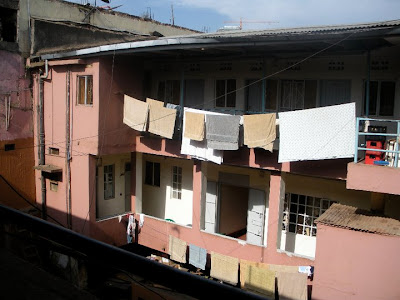 View of the guest house courtyard. Many other Ethiopians live here.
The food is delicious! And super cheap for bounteous quantities of food. Though there is a strict leave nothing on your plate rule, which has resulted in Injera snuck out in purses on many occasions.
One time we were there, Madam offered to teach us how to cook the food, so last Sunday, Hannah, Ali, and I went for a lesson. We learned how to make the traditional Ethiopian salad, and the vegetarian dish shown below:

Madam measuring out the all important Ethiopian spices
 The aforementioned dish, bubbling away on the stove.
And now for something completely different, bucket list item 3: white water rafting on the Nile
Yes friends, after 20 plus years of life as a nerd, I have become a bad ass. I know. You're shocked. But it's true, and I have the bruises and sun burns to prove it.
The day after thanksgiving, ten of the SIT crew took to the Nile river for a day of Class 5 rapids. It was so much fun: totally crazy and terrifying, but I always felt safe and just had an awesome time. I thought I was so legitimate having rafted a couple times in Colorado.... but lets just say that the class 3s and 4s on the Colorado river are nothing compared to the class 5s on the Nile. Here's a little taste of what we did.
After a long day of rafting, we got to spend the night at the lodge of the rafting company we used, which could not be more beautiful. I will let the pictures do it justice:
 The sunset view from our lodge... yeah, this doesn't suck.

 Drinking Nile... on the Nile!!
I have a couple more items on my bucket list, and I will be sure to tell you about them as I check them off. I look forward to completing them and adding to the unbelievably long list of incredible memories I will take with me from Uganda.
Also, tonight is the first night of Chanukah!! I made some latkes, which of course didn't taste nearly as good as Mom's, but a gal can try, right? I hope those of you who celebrate had a wonderful first night!!
A few weeks ago, Ali, Hannah and I sat down and made a bucket list of things we wanted to do before we leave Uganda. This blog is about three of the things on that list.
Bucket list item number 1: Learn how to cook Ugandan food.
So I miss a lot of American food. In fact I have come to realize that I have professed my longing for cheese a bit too much. So, sorry for that. The love of a girl and pasturized dairy products is not to be messed with.
However, I am going to miss a lot of Ugandan food too, so I employed my friend Erin, and our Kenyan friends Brian and Henry to come over and teach me how to cook omuceere (rice), emboga (cabbage), ebijanjalo (beans), and chapati. So now I am an expert Ugandan chef, and I have decided that I am having a study abroad potluck when I get home, so if you want to try Ugandan food you are invited. And if you are currently studying abroad, you must come and cook food from where you're studying. That is the deal.
Bucket list item number 2: Learn how to cook Ethiopian food.
Who knew so many of my bucket list items would have to do with food?? My friends and I have taken to frequenting this Ethiopian restaurant.... though I fear that restaurant is not quite the right term, as this place is the epitome of hole in the wall. You wind your way through the crowded streets near Old Park (the subject of my next post), enter a guest house through an alleyway, climb up several flights of stairs, walk into a small kitchen and call "hello madam?" Then, a lovely Ethiopian woman will come into the kitchen, take your order, and will eventually serve you in her living room.

Ali, Alena, Hannah, and Madam on the balcony outside her house/restaurant
 View of the guest house courtyard. Many other Ethiopians live here.
The food is delicious! And super cheap for bounteous quantities of food. Though there is a strict leave nothing on your plate rule, which has resulted in Injera snuck out in purses on many occasions.
One time we were there, Madam offered to teach us how to cook the food, so last Sunday, Hannah, Ali, and I went for a lesson. We learned how to make the traditional Ethiopian salad, and the vegetarian dish shown below:

Madam measuring out the all important Ethiopian spices
 The aforementioned dish, bubbling away on the stove.
Yes friends, after 20 plus years of life as a nerd, I have become a bad ass. I know. You're shocked. But it's true, and I have the bruises and sun burns to prove it.
The day after thanksgiving, ten of the SIT crew took to the Nile river for a day of Class 5 rapids. It was so much fun: totally crazy and terrifying, but I always felt safe and just had an awesome time. I thought I was so legitimate having rafted a couple times in Colorado.... but lets just say that the class 3s and 4s on the Colorado river are nothing compared to the class 5s on the Nile. Here's a little taste of what we did.
After a long day of rafting, we got to spend the night at the lodge of the rafting company we used, which could not be more beautiful. I will let the pictures do it justice:
 The sunset view from our lodge... yeah, this doesn't suck.
 Drinking Nile... on the Nile!!
I have a couple more items on my bucket list, and I will be sure to tell you about them as I check them off. I look forward to completing them and adding to the unbelievably long list of incredible memories I will take with me from Uganda.
Also, tonight is the first night of Chanukah!! I made some latkes, which of course didn't taste nearly as good as Mom's, but a gal can try, right? I hope those of you who celebrate had a wonderful first night!!
Sunday, November 28, 2010
A Very Ugandan Thanksgiving
Hello all! I hope you guys had absolutely wonderful thanksgivings!! For those with whom I usually celebrate, I was missing you all very very much, and for those with whom I don’t usually get to celebrate, I was thinking of all of you and am thankful for you all.
So I had a very Ugandan thanksgiving this year! Of course, thanksgiving is not a celebrated holiday in Uganda. (Though it involves lots and lots of eating so I feel like it was practically made for Ugandans, you know, besides the whole discovering America-thanks for the meal-here are some blankets as tokens of our appreciation-thing.) As a result, us Bazungu were facing the prospect of a thanksgivingless year, a prospect that just wouldn’t do! So we decided to create our own thanksgiving celebration.
Hannah and I spearheaded the cooking effort, which was an adventure to say the least. Our kitchen is tiny, our oven is broken, and we have a grand total of two pots, so the prospect of feeding 17 seemed daunting. However, we were determined. We had a plan. I dedicated several desktop sticky notes to menus, attendance lists and shopping schedules.
Wednesday night, we would make the mashed potatoes, which would take the most time of anything, to have enough time/burners/pots to make the rest of the dishes on Thursday. However, soon after we started cooking, the power went out. No worries! The mashed potatoes would be made by the light of two headlamps!
On Thursday, I took off of work early to finish cooking. About an hour into cooking, the gas runs out of our stove. Visions of pathetically asking neighbors to use their stoves or, the horror!, a matoke-laden thanksgiving, flashed before my eyes. However, our wonderful landlord Eric soon came to the rescue with a new (though I’m pretty sure it was just his gas canister and not a new canister at all- my thanksgiving hero) canister of gas. So we were back on track. The guests were due at 7. The power went out at 6. Bring out the headlamps!

Look! It still works! Thank you Eric!!!

Oh tiny stove, I am glad that you work during power outages!
However, in the end, all of the food got made, a menu of mashed potatoes, candied sweet potatoes (my mom’s recipe!), green beans, vegetable rice, and cabbage salad. The guests arrived, all bringing exactly what we’d coordinated ( how wonderful when you have friends who follow through and call you during the day to ask if they can bring anything else!), and we had an absolutely fantastic thanksgiving by the light of headlamps! ( I like how the last three paragraphs end in "headlamps!"-- This thanksgiving is brought to you by the letter headlamps!)


I think we employed every single dish in the kitchen in our effort
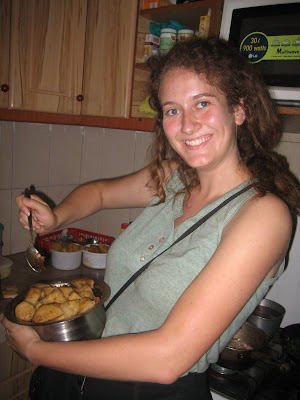

After several hours of cooking, chefs Alena and Hannah are excited to eat!
As is the tradition of many of the students there, we all went around and said what we’re thankful for. I said that, in anticipating my first thanksgiving away from home- the first thanksgiving any Stern has spent away from home- I was expecting to feel incredibly sad. But instead, as I looked around the room at the faces of my friends crammed into my tiny living room, illuminated only by an open laptop and two headlamps, whatever sadness I expected to feel was replaced by overwhelming love for the people around me. I am so lucky to have found such an amazing family here in Uganda.
I skyped with my parents last night, and they reminded, as they are wont to do, that I will be seeing them in 12 days. This ever waning countdown, of course, is one of very mixed emotions. On the one hand, I am so excited to see my family and for the adventure we are going to embark on together. I am so excited to return to America, land of my puppy and diet coke and cheese. And I am so excited for getting back to my W&M family next semester. However, I am also unspeakably saddened at the prospect of leaving Uganda, a place that has come to be my home, the prospect of leaving 16 friends, who have become my family, and the prospect of the conclusion of this experience that has challenged me, delighted me, sometimes frustrated me, and has exceeded my expectations in every possible way.
I have realized that no one emotion is ever going to win out, and in a way, I am so thankful for that. Many people search all their lives for one place to call home, and at the ripe old age of twenty, I have already found three homes, filled with three different, wonderful, loving families.
I have so very very much to be thankful for. Happy Thanksgiving.
So I had a very Ugandan thanksgiving this year! Of course, thanksgiving is not a celebrated holiday in Uganda. (Though it involves lots and lots of eating so I feel like it was practically made for Ugandans, you know, besides the whole discovering America-thanks for the meal-here are some blankets as tokens of our appreciation-thing.) As a result, us Bazungu were facing the prospect of a thanksgivingless year, a prospect that just wouldn’t do! So we decided to create our own thanksgiving celebration.
Hannah and I spearheaded the cooking effort, which was an adventure to say the least. Our kitchen is tiny, our oven is broken, and we have a grand total of two pots, so the prospect of feeding 17 seemed daunting. However, we were determined. We had a plan. I dedicated several desktop sticky notes to menus, attendance lists and shopping schedules.
Wednesday night, we would make the mashed potatoes, which would take the most time of anything, to have enough time/burners/pots to make the rest of the dishes on Thursday. However, soon after we started cooking, the power went out. No worries! The mashed potatoes would be made by the light of two headlamps!
On Thursday, I took off of work early to finish cooking. About an hour into cooking, the gas runs out of our stove. Visions of pathetically asking neighbors to use their stoves or, the horror!, a matoke-laden thanksgiving, flashed before my eyes. However, our wonderful landlord Eric soon came to the rescue with a new (though I’m pretty sure it was just his gas canister and not a new canister at all- my thanksgiving hero) canister of gas. So we were back on track. The guests were due at 7. The power went out at 6. Bring out the headlamps!

Look! It still works! Thank you Eric!!!

Oh tiny stove, I am glad that you work during power outages!
However, in the end, all of the food got made, a menu of mashed potatoes, candied sweet potatoes (my mom’s recipe!), green beans, vegetable rice, and cabbage salad. The guests arrived, all bringing exactly what we’d coordinated ( how wonderful when you have friends who follow through and call you during the day to ask if they can bring anything else!), and we had an absolutely fantastic thanksgiving by the light of headlamps! ( I like how the last three paragraphs end in "headlamps!"-- This thanksgiving is brought to you by the letter headlamps!)


I think we employed every single dish in the kitchen in our effort


After several hours of cooking, chefs Alena and Hannah are excited to eat!
As is the tradition of many of the students there, we all went around and said what we’re thankful for. I said that, in anticipating my first thanksgiving away from home- the first thanksgiving any Stern has spent away from home- I was expecting to feel incredibly sad. But instead, as I looked around the room at the faces of my friends crammed into my tiny living room, illuminated only by an open laptop and two headlamps, whatever sadness I expected to feel was replaced by overwhelming love for the people around me. I am so lucky to have found such an amazing family here in Uganda.
I skyped with my parents last night, and they reminded, as they are wont to do, that I will be seeing them in 12 days. This ever waning countdown, of course, is one of very mixed emotions. On the one hand, I am so excited to see my family and for the adventure we are going to embark on together. I am so excited to return to America, land of my puppy and diet coke and cheese. And I am so excited for getting back to my W&M family next semester. However, I am also unspeakably saddened at the prospect of leaving Uganda, a place that has come to be my home, the prospect of leaving 16 friends, who have become my family, and the prospect of the conclusion of this experience that has challenged me, delighted me, sometimes frustrated me, and has exceeded my expectations in every possible way.
I have realized that no one emotion is ever going to win out, and in a way, I am so thankful for that. Many people search all their lives for one place to call home, and at the ripe old age of twenty, I have already found three homes, filled with three different, wonderful, loving families.
I have so very very much to be thankful for. Happy Thanksgiving.
Tuesday, November 16, 2010
Dreckitude!
Hello all! I hope you all had lovely weekends! I was a little hurt that no one commented on my most recent blog post, but I decided to get over the pain, learn how to love again, and write another post.
You are likely asking, “what is “dreckitude,” exactly?” Well, my dear confused reader, it is a word pioneered by Vogue Editor and more importantly America’s Next Top Model (oddly, one of the few American shows we get on our TV in the Muzungu House, as it has lovingly been named) judge, Andre Leon Talley. “And why do you insist on undermining the gravity of your posts by making inane pop culture references?,” you now ask. Well, that cannot be answered in the time we have, but good use of the word “inane” back there, imagined voice of my aggregated readers!
So I figured it was about time to give you all an update on my internship, since I am over halfway through my practicum and what not (ahhhhh!!). Over these past two weeks, “dreckitude” is a word that has been popping into my head quite a bit as I try to navigate the complicated, dizzying, and often maddening world of foreign aid transparency.
One of the things that always amuses/confounds me about foreign aid is that, as it seems to me, it is a system that was built in a manner that is completely incompatible with its goals. Of course, the presumptive goals of the system have also changed since its creation.
AidData holds foreign aid records dating back to the 1950s. However, no one could have said that foreign aid was really attempting any goal other than fighting the spread of communism until after the specter of the Cold War had settled. This means that for the first fourty-ish years of the existence of foreign aid institutions, they were designed to achieve a purpose that is far different then they are now.
Of course, there are many who would argue that aid is still predominantly political in motivation, only now the aim is co-opting UN votes or access to natural resources, instead of fighting the red tide. This is one of the things that I find so fascinating about foreign aid: The idea that foreign aid can and should achieve the nebulous idea of “development” is an idea that, at best, is only 20 years old, and many think is still a nascent idea.
This summer, I worked on the World Bank on the mapping for results project, which I wrote a couple of blog posts about here and here. Also, if you want to look at some pretty maps I helped create, you can look here.
The aim of this project was to gain a better picture of aid, due to the very general information that generally exists about foreign aid, which I discussed in this post. One of the most frustrating things about that project would be when I would read through (cough skim cough) hundreds of pages of documentation just to find that “these 30 schools were built in Northern Uganda.” But where in Northern Uganda??? How can you expect anyone on the ground to know if their representative has swindled away the money that was supposed to build them a school when the most specific information we can get about the location of those schools is a region of a country?? That would be like saying that ten schools are being built on the east coast and expecting someone in Lancaster County PA to both somehow know that they are supposed to be getting a school and speak out when one does not show up. (To be fair, the good people of Lancaster County might be able to magically know about fictional aid flows, if their ability to make delicious delicious pretzels is any indication of their psychic abilities…. Mmmmm who wants to send me some pretzels? And some cheese!!!)
The other frustrating thing, food diversions aside, was knowing that someone in the World Bank, perhaps someone sitting less than a block away from me, has perfect information, knows exactly where those villages were built, and yet I was unable to find out who that person is and how to get that information. One of the good outcomes of that summer was the introduction of a discussion of adding a standardized location field to World Bank documents, so there would be a set place to look for the location of a project. However, this would only specify location to the district level, and wasn’t even a sure thing. Yet, in even considering this measure, the World Bank stands as a leader in its field.
Of course, I always wonder why, in 2010, it is just now seeming like an important idea to the World Bank to specifically record where their projects are, a task that would take the person implementing the project on the ground about 5 minutes. But this is just another one of those things that remind me that aid agencies were not necessarily designed in the best way to achieve what their stated goals have become.
The dreckitude that characterizes the record-keeping of project locations at the World Bank is certainly not unique to that organization. UNICEF has plenty of its own problems, which have injected a good bit of frustration into my first three weeks. I essentially have spent the last three weeks trying to understand how UNICEF records and organizes its aid information, who within the organization holds which information, how each piece of information can be used, and perhaps most importantly, how I can get my over-eager little hands on the information I need.
This process has proven difficult as I have found myself hitting many dead ends. However, I had a great Monday (today was a public holiday for Eid al-Adha so I didn’t have work) at work in which all the pieces seemed to fall together. It was the first day of my practicum that I actually felt that I would be able to accomplish the prototype website, the output that I have been hoping to produce from my six weeks at UNICEF.
However, much ridiculousness still exists. For example, all of the reports from the implementers on the ground only exist in HARDCOPY. That’s right, there is no electronic record of the only documents that detail specific project locations, beyond the district level. So in order to find specifically where UNICEF is working, I will have to dig through hundreds of pages of paper. Oy. Moreover, there is absolutely no way for anyone outside UNICEF to have access to this information, the information a citizen would need to hold their representatives accountable for the aid they are supposed to receive. However, the one of the most exciting things about my project is how much commitment there is within the UNICEF Uganda office to organizing themselves in the best possible way to achieve development outcomes.
In my discussions with my boss, he has seemed excited about the idea of making changes to the current reporting system to be able to feed the necessary information into the system so that it will be sustainable without an intern doing the grunt work to pull the scattered pieces together. So all in all, I am feeling optimistic right now, which feels pretty darn good!
As things start moving, I’ll try to write more often about how the project is coming!
With love and smizing,
Alena
Monday, November 8, 2010
If not now, when?
Hello blog readers!! I am sorry it has been so very long since I have updated my blog. I have no excuses really, just an epically long blog post that I hope will make up for it. I have debated for a while whether to include part of this post, but in the end I decided to go for it. I am sorry if it is too much of a downer, but sometimes that is life. (Oh boy I can ONLY IMAGINE what is going through my parents’ heads right now- don’t worry, all is fine!)
A week ago, Ali and I went to the grocery store to purchase the supplies for what was ultimately a very successful attempt at vegetable stir fry with Thai-peanut sauce (ahh… the perks of having my own kitchen). As we were leaving the store, Ali and I were commenting on what a successful grocery store trip it had been, and I was looking through my bag to make sure I had everything when…
“Oh my god, Alena.” Ali blurted out. “Oh my god, Alena.”
I looked up from my bag and followed her gaze to the point on which it had fixed. Across the street, in the open doorway of a small shop, a man stood, holding his wife by the collar of her Gomez, beating her with a closed fist. My mind went blank. I froze. I didn’t know what to do. And the man kept beating his wife, screaming at her in Luganda. I didn’t understand what he was saying, I imagine we didn’t learn those words in Luganda class, but it didn’t matter. All I could think was that I was witnessing domestic abuse before my eyes.
Fortunately, before I could even complete those thoughts, two Ugandan men on the street ran over to the shop door, one restraining the husband and the other leading away the crying wife.
Ali and I began to walk back to our house, and we didn’t say much on the walk back. Though I was relieved that the two men on the street had stopped the immediate abuse, all I could think about was what would happen when that wife returned to her home that night, what her life would be like. I knew the story wasn’t over, and I doubted it will have a happy ending.
I felt so powerless, but what could I have done? I knew that trying to stop the abuse myself would have been both incredibly dangerous and ultimately inefficacious. Certainly I am not strong enough to restrain an angry man, and I wouldn’t have wanted to end up on the other end of his fist. Also, as a muzungu, I don’t exactly get lost in the crowd, so intervening would have been unsafe.
Moreover, intervention by a muzungu probably would be a further source of embarrassment and might ultimately make things worse for the woman.
But still, what about the long run, the end of that woman’s story? Isn’t there a way to bring about a happier ending?
Domestic abuse in Uganda is a troubling thing. Whenever we meet with organizations that say they help women experiencing domestic abuse, I always ask what exactly the organization advises the woman to do, and what sort of resources exist for a woman in that situation. The answer I get is always that “we provide marital counseling to help the couple end the abuse in their relationship.” This boggles my mind. Marital counseling?? You really expect a woman to “work it out” with a man that is abusing her?? And what if counseling doesn’t work? Then what??
In America, if domestic abuse occurs, my sense is that most organizations would get the victim the heck out of that house, setting them up in some sort of shelter. However, the reality in Uganda is that such shelters do not exist. So what happens if a woman decides to leave?
She would likely only have claim to the possessions she is able to grab. Though women did gain the right to own land in the 1998 Land Act, most land is governed by traditional village mechanisms, rendering women with access to land only through male relatives. Thus, a woman who leaves her husband has no claim to the land they built and tended together.
She would also likely be the object of scorn, and could bring shame to her family, who might not take her back in. She might no longer be seen as marriageable.
So what does she do? She probably decides to stay with her husband, perhaps to attend counseling, if he’s willing, and try to “work it out” with the man that is abusing her.
Now, this certainly paints with a broad brush, and many courageous women do leave their husbands. But many societal forces are stacked against them. And in the face of such societal forces, it’s hard to see what one person can do.
This Friday, Ali and I went to spend Shabbat with the Abayudaya tribe in Eastern Uganda. The tribe originates with a Buganda military leader, Semei Kakungulu, who was converted to Christianity by British missionaries in 1880. As he began to study Christianity, he began to believe the lessons in the first 5 books of Moses (aka the Torah) were the truth. When Muslim immigrants told Kakungulu that only Jews follow only the Torah, he is believed to have said “Then we will be Jewish!”
After Kakungulu died in 1928, his followers divided into two groups: one reverted to Christianity and the other, the Abayudaya, became devoutly Jewish. The Abayudaya isolated themselves to avoid chronic persecution, which became its most intense under Idi Amin, who outlawed Jewish rituals and destroyed synagogues. During Amin’s reign, some 80–90% of the Abayudaya community converted to either Christianity or Islam to escape persecution. Only 300 Abaydaya remained committed to Judaism, worshipping in secret. This group named itself the “She’erit Yisrael,” the Remnant of Israel.
The most well known group of Abayudaya live in the village of Namanyoyi and practice Conservative Judaism. They are particularly renowned for their music, which has been nominated for a Grammy award. You can listen to a sample here:
Ali and I took a bus from Kampala at 3pm which got us into Mbale at 7pm. We were picked up by a very apologetic Rabbi Gershom who was breaking Shabbos, as he kept insisting, for the first time ever. Apparently, the Rabbi is running for a seat in Parliament and had to attend a primary election in which he received 100% of the vote (ahhh the Ugandan electoral system… keeping it classy). Unfortunately, we missed the singing because we arrived at the tail end of Kabbalat Shabbat, but the Rabbi welcomed us into his home where a few funny things happened:
First, the Rabbi’s adorable three-ish year old daughter immediately ran up to Ali and me and demanded we play with her. The first book she grabbed was “The Very Hungry Caterpillar,” a book that holds a central place in my childhood. I didn’t know that this was a universal thing.
Second, we met Isaac, a nephew of the Rabbi who was wearing a shirt that read “Nate’s Bar Mitzvah 1999.” As a brief aside, it is very common to see Ugandans wearing clothing, that clearly was given away by Americans. The Bar Mitzvah t-shirt worn by Isaac is one example, and I can so clearly imagine a Jewish kid in Uganda walking into a market and getting super excited to see a Bar Mitzvah t-shirt. Other notable examples include seeing a man wearing a pink sorority t-shirt and seeing so many corporate conference t-shirts that immediately went from conference to charity pile. I always half expect to see a shirt that I’ve given away here, but that has yet to occur.
Third, one of the American tourists visiting the village for Shabbat was from Kansas. When I said I was from Colorado she asked me if I had ever gone to summer camp. It turns out she went to Shwayder camp (Booo!) which is the rival summer camp to JCC Ranch Camp, where I attended/worked for 8 years. It is truly a small world indeed.
The Rabbi led Kiddush and then invited Ali and I to have dinner in his home, while the rest of the many Israeli and American tourists went back to the Guest House for dinner. Following dinner, we all sat around and discussed the D’var Torah and other teachings from the Torah. The Rabbi revealed that his personal favorite teaching, which I quote below:
-Oh Hashem! That we would forget for a moment that oppressing thought: That everything has been tried already, thousands upon thousands of time. That we would for a moment forget all this!... But when will this moment come? When will it be sought? When will it be found? Every generation asks this same question, and every generation answers with greater despair: "Who knows?"
-"But one truth I know! This response may be adequate for Mankind, even Klal Yisroel, in general. But an individual - can you the individual who sits and reads these simple lines respond any other way to my question "when?" than with the reply of Hillel: "If not now... when?!"
The Rabbi stated that he teaches this parsha with the lesson that people should not wait to take action “because today is the only day you control. Yesterday has passed and tomorrow is out of reach.”
I have thought a lot about his words the last couple of days. “If not now, when?” The question implores you to take action, commands you not to make excuses for delaying even a moment longer. I feel like I live a lot of my life for the future: I do research so that, someday, someone will learn from the research and implement change. I have come to Uganda to learn so that, someday, I can come back to Uganda to work towards a better life for the people who have given me so much in this country. However I realize that this is not a satisfactory answer to the Rabbi’s question, and I also realize that some of the people who have so touched my life during my time in Uganda won’t be here when someday finally rolls around.
The nature of my role in this country is something that I have struggled with, and I know the other students have struggled with as well. When we were conducting “research” on our rural homestays, one of the other students had a very adverse reaction to the whole process. She felt that “dropping in” on a community and disrupting their lives for a few days in the name of “research” that ultimately won’t benefit them was unethical.
By contrast, I was of the opinion that expecting that I, armed with nothing more than a notebook and a loosely defined research question, could change anyone’s life in three days was not only impossible, but ultimately hubristic. Moreover, is it my role as a Muzungu, an outsider in this community, to try and change anything? To try and play savior? The question is not only what I can do, but what I should do.
However, if to believe that I can change everything is the height of hubris, to resign myself to being powerless to affect change is the height of cowardice.
Saturday morning, Ali and I traveled to the nearby Orthodox community of the Putti village. The Putti Jewish community is far less well known than the Namanyoyi community, and is decidedly poorer as well. When we arrived, we were ushered into a one room mud synagogue, where a high school kid in an “Australia” t-shirt and impossibly shiny shoes led services, we were later told for the first time. He stood on a cement bimah, facing a wooden ark with paint chipping, as children in tattered clothes ran around the small room.
Following the services, the Rabbi told us of the community’s needs. Their only income used to come from selling Kippot and recording music, until a Jewish NGO came in and helped them set up a poultry farm to sell eggs. He implored us to help him find more donors, to help raise money for the community. This summer, Ali was involved in a drive to help raise money and school supplies to help the families of the Putti village send their children to school. The money hasn’t been brought to the community yet, but when it does, I know it will make a difference in the lives of the Putti people.
It is clear to me that waiting for “someday” is not good enough. “Someday,” the children of the Putti village will have already missed their chance to go to school. “Someday,” the AIDS victims I met in the Bwaise slums will have passed away if they don’t get the anti-retrovirals they so desperately need. “Someday,” the malnourished children running around my rural homestay will be adults with chronic health problems, if they even make it that far.
Yet, I know that some things must wait until someday. There will be no real help for victims of domestic abuse in this country until societal values change, which is a process that takes time. It is a sad reality of life that the woman whose nightmare I witnessed must continue to suffer until “someday” rolls around. However, as I pledged in one of my first posts, though these sad realities of life surround me every day, I must not accept them and grow complacent in the face of large mountains to climb. Instead, I must figure out what role I can play, and do what I can to bring about “someday” a few days sooner.
When I was much younger, I was shopping for a present for my mom’s birthday, or Mother’s Day, I cannot quite recall now, I stumbled upon a card with a message that I thought appropriate for my mom’s life, and as I am my mother’s daughter, it has become appropriate for mine as well.
Of course, it wasn’t until several years after I had lovingly painted it on a wooden plaque, which now hangs in my kitchen, that I learned that it was the Serenity Prayer, which is also the Alcoholics Anonymous motto. However, despite its notorious association, it remains one of my favorite quotes:
It feels especially appropriate now, as I try to understand my role in this country now and in its future. I hope to eventually be able to wait for “someday” with serenity when necessary, but mostly, whenever humanly possible, to bring “someday” ever closer with courage. But, for now, I’ll just take the wisdom to know the difference.
A week ago, Ali and I went to the grocery store to purchase the supplies for what was ultimately a very successful attempt at vegetable stir fry with Thai-peanut sauce (ahh… the perks of having my own kitchen). As we were leaving the store, Ali and I were commenting on what a successful grocery store trip it had been, and I was looking through my bag to make sure I had everything when…
“Oh my god, Alena.” Ali blurted out. “Oh my god, Alena.”
I looked up from my bag and followed her gaze to the point on which it had fixed. Across the street, in the open doorway of a small shop, a man stood, holding his wife by the collar of her Gomez, beating her with a closed fist. My mind went blank. I froze. I didn’t know what to do. And the man kept beating his wife, screaming at her in Luganda. I didn’t understand what he was saying, I imagine we didn’t learn those words in Luganda class, but it didn’t matter. All I could think was that I was witnessing domestic abuse before my eyes.
Fortunately, before I could even complete those thoughts, two Ugandan men on the street ran over to the shop door, one restraining the husband and the other leading away the crying wife.
Ali and I began to walk back to our house, and we didn’t say much on the walk back. Though I was relieved that the two men on the street had stopped the immediate abuse, all I could think about was what would happen when that wife returned to her home that night, what her life would be like. I knew the story wasn’t over, and I doubted it will have a happy ending.
I felt so powerless, but what could I have done? I knew that trying to stop the abuse myself would have been both incredibly dangerous and ultimately inefficacious. Certainly I am not strong enough to restrain an angry man, and I wouldn’t have wanted to end up on the other end of his fist. Also, as a muzungu, I don’t exactly get lost in the crowd, so intervening would have been unsafe.
Moreover, intervention by a muzungu probably would be a further source of embarrassment and might ultimately make things worse for the woman.
But still, what about the long run, the end of that woman’s story? Isn’t there a way to bring about a happier ending?
Domestic abuse in Uganda is a troubling thing. Whenever we meet with organizations that say they help women experiencing domestic abuse, I always ask what exactly the organization advises the woman to do, and what sort of resources exist for a woman in that situation. The answer I get is always that “we provide marital counseling to help the couple end the abuse in their relationship.” This boggles my mind. Marital counseling?? You really expect a woman to “work it out” with a man that is abusing her?? And what if counseling doesn’t work? Then what??
In America, if domestic abuse occurs, my sense is that most organizations would get the victim the heck out of that house, setting them up in some sort of shelter. However, the reality in Uganda is that such shelters do not exist. So what happens if a woman decides to leave?
She would likely only have claim to the possessions she is able to grab. Though women did gain the right to own land in the 1998 Land Act, most land is governed by traditional village mechanisms, rendering women with access to land only through male relatives. Thus, a woman who leaves her husband has no claim to the land they built and tended together.
She would also likely be the object of scorn, and could bring shame to her family, who might not take her back in. She might no longer be seen as marriageable.
So what does she do? She probably decides to stay with her husband, perhaps to attend counseling, if he’s willing, and try to “work it out” with the man that is abusing her.
Now, this certainly paints with a broad brush, and many courageous women do leave their husbands. But many societal forces are stacked against them. And in the face of such societal forces, it’s hard to see what one person can do.
This Friday, Ali and I went to spend Shabbat with the Abayudaya tribe in Eastern Uganda. The tribe originates with a Buganda military leader, Semei Kakungulu, who was converted to Christianity by British missionaries in 1880. As he began to study Christianity, he began to believe the lessons in the first 5 books of Moses (aka the Torah) were the truth. When Muslim immigrants told Kakungulu that only Jews follow only the Torah, he is believed to have said “Then we will be Jewish!”
After Kakungulu died in 1928, his followers divided into two groups: one reverted to Christianity and the other, the Abayudaya, became devoutly Jewish. The Abayudaya isolated themselves to avoid chronic persecution, which became its most intense under Idi Amin, who outlawed Jewish rituals and destroyed synagogues. During Amin’s reign, some 80–90% of the Abayudaya community converted to either Christianity or Islam to escape persecution. Only 300 Abaydaya remained committed to Judaism, worshipping in secret. This group named itself the “She’erit Yisrael,” the Remnant of Israel.
The most well known group of Abayudaya live in the village of Namanyoyi and practice Conservative Judaism. They are particularly renowned for their music, which has been nominated for a Grammy award. You can listen to a sample here:
Ali and I took a bus from Kampala at 3pm which got us into Mbale at 7pm. We were picked up by a very apologetic Rabbi Gershom who was breaking Shabbos, as he kept insisting, for the first time ever. Apparently, the Rabbi is running for a seat in Parliament and had to attend a primary election in which he received 100% of the vote (ahhh the Ugandan electoral system… keeping it classy). Unfortunately, we missed the singing because we arrived at the tail end of Kabbalat Shabbat, but the Rabbi welcomed us into his home where a few funny things happened:
First, the Rabbi’s adorable three-ish year old daughter immediately ran up to Ali and me and demanded we play with her. The first book she grabbed was “The Very Hungry Caterpillar,” a book that holds a central place in my childhood. I didn’t know that this was a universal thing.
Second, we met Isaac, a nephew of the Rabbi who was wearing a shirt that read “Nate’s Bar Mitzvah 1999.” As a brief aside, it is very common to see Ugandans wearing clothing, that clearly was given away by Americans. The Bar Mitzvah t-shirt worn by Isaac is one example, and I can so clearly imagine a Jewish kid in Uganda walking into a market and getting super excited to see a Bar Mitzvah t-shirt. Other notable examples include seeing a man wearing a pink sorority t-shirt and seeing so many corporate conference t-shirts that immediately went from conference to charity pile. I always half expect to see a shirt that I’ve given away here, but that has yet to occur.
Third, one of the American tourists visiting the village for Shabbat was from Kansas. When I said I was from Colorado she asked me if I had ever gone to summer camp. It turns out she went to Shwayder camp (Booo!) which is the rival summer camp to JCC Ranch Camp, where I attended/worked for 8 years. It is truly a small world indeed.
The Rabbi led Kiddush and then invited Ali and I to have dinner in his home, while the rest of the many Israeli and American tourists went back to the Guest House for dinner. Following dinner, we all sat around and discussed the D’var Torah and other teachings from the Torah. The Rabbi revealed that his personal favorite teaching, which I quote below:
-Oh Hashem! That we would forget for a moment that oppressing thought: That everything has been tried already, thousands upon thousands of time. That we would for a moment forget all this!... But when will this moment come? When will it be sought? When will it be found? Every generation asks this same question, and every generation answers with greater despair: "Who knows?"
-"But one truth I know! This response may be adequate for Mankind, even Klal Yisroel, in general. But an individual - can you the individual who sits and reads these simple lines respond any other way to my question "when?" than with the reply of Hillel: "If not now... when?!"
The Rabbi stated that he teaches this parsha with the lesson that people should not wait to take action “because today is the only day you control. Yesterday has passed and tomorrow is out of reach.”
I have thought a lot about his words the last couple of days. “If not now, when?” The question implores you to take action, commands you not to make excuses for delaying even a moment longer. I feel like I live a lot of my life for the future: I do research so that, someday, someone will learn from the research and implement change. I have come to Uganda to learn so that, someday, I can come back to Uganda to work towards a better life for the people who have given me so much in this country. However I realize that this is not a satisfactory answer to the Rabbi’s question, and I also realize that some of the people who have so touched my life during my time in Uganda won’t be here when someday finally rolls around.
The nature of my role in this country is something that I have struggled with, and I know the other students have struggled with as well. When we were conducting “research” on our rural homestays, one of the other students had a very adverse reaction to the whole process. She felt that “dropping in” on a community and disrupting their lives for a few days in the name of “research” that ultimately won’t benefit them was unethical.
By contrast, I was of the opinion that expecting that I, armed with nothing more than a notebook and a loosely defined research question, could change anyone’s life in three days was not only impossible, but ultimately hubristic. Moreover, is it my role as a Muzungu, an outsider in this community, to try and change anything? To try and play savior? The question is not only what I can do, but what I should do.
However, if to believe that I can change everything is the height of hubris, to resign myself to being powerless to affect change is the height of cowardice.
Saturday morning, Ali and I traveled to the nearby Orthodox community of the Putti village. The Putti Jewish community is far less well known than the Namanyoyi community, and is decidedly poorer as well. When we arrived, we were ushered into a one room mud synagogue, where a high school kid in an “Australia” t-shirt and impossibly shiny shoes led services, we were later told for the first time. He stood on a cement bimah, facing a wooden ark with paint chipping, as children in tattered clothes ran around the small room.
Following the services, the Rabbi told us of the community’s needs. Their only income used to come from selling Kippot and recording music, until a Jewish NGO came in and helped them set up a poultry farm to sell eggs. He implored us to help him find more donors, to help raise money for the community. This summer, Ali was involved in a drive to help raise money and school supplies to help the families of the Putti village send their children to school. The money hasn’t been brought to the community yet, but when it does, I know it will make a difference in the lives of the Putti people.
It is clear to me that waiting for “someday” is not good enough. “Someday,” the children of the Putti village will have already missed their chance to go to school. “Someday,” the AIDS victims I met in the Bwaise slums will have passed away if they don’t get the anti-retrovirals they so desperately need. “Someday,” the malnourished children running around my rural homestay will be adults with chronic health problems, if they even make it that far.
Yet, I know that some things must wait until someday. There will be no real help for victims of domestic abuse in this country until societal values change, which is a process that takes time. It is a sad reality of life that the woman whose nightmare I witnessed must continue to suffer until “someday” rolls around. However, as I pledged in one of my first posts, though these sad realities of life surround me every day, I must not accept them and grow complacent in the face of large mountains to climb. Instead, I must figure out what role I can play, and do what I can to bring about “someday” a few days sooner.
When I was much younger, I was shopping for a present for my mom’s birthday, or Mother’s Day, I cannot quite recall now, I stumbled upon a card with a message that I thought appropriate for my mom’s life, and as I am my mother’s daughter, it has become appropriate for mine as well.
Of course, it wasn’t until several years after I had lovingly painted it on a wooden plaque, which now hangs in my kitchen, that I learned that it was the Serenity Prayer, which is also the Alcoholics Anonymous motto. However, despite its notorious association, it remains one of my favorite quotes:
God, grant me the serenity
To accept the things I cannot change;
Courage to change the things I can;
And wisdom to know the difference.
To accept the things I cannot change;
Courage to change the things I can;
And wisdom to know the difference.
It feels especially appropriate now, as I try to understand my role in this country now and in its future. I hope to eventually be able to wait for “someday” with serenity when necessary, but mostly, whenever humanly possible, to bring “someday” ever closer with courage. But, for now, I’ll just take the wisdom to know the difference.
Subscribe to:
Posts (Atom)